
What does a Veterinary Technician Do?
 Veterinary technicians are trained professionals who do far more than assist. Here are the key facts about the role, its demands, and its outlook.
- Vet techs earn an associate’s degree and pass a national exam before moving on to patient care under a Veterinarian’s supervision.
- Beyond clinical tasks, 79% of vet techs teach pet owners how to give medication, and face-to-face talks remain the top way owners learn about animal care.
- The U.S. Bureau of Labor Statistics expects 9% job growth for vet techs through 2034, with about 14,300 openings expected each year.
- Vet techs and vet assistants are not the same role. Vet techs have a wider scope of practice, including X-ray imaging, anesthesia monitoring, and advanced diagnostics.
- Specializing in areas like dentistry, anesthesia, or emergency care can lead to higher pay, more independence, and stronger long-term career satisfaction.
What Is a Veterinary Technician
The American Animal Hospital Association says clinics do better when they make full use of trained vet techs. Careers last longer. Teams trust each other and work well together. Patients get better care, and the practice earns more money.
Most people know what a veterinarian does. But the person standing next to them during almost every procedure often gets overlooked. A veterinary technician is not just a helper. Vet techs are trained clinical professionals who play a central role in patient care. They handle the tasks that keep an animal hospital running, from the first appointment to the last.
Veterinary technicians, often called vet techs, work under the supervision of licensed veterinarians. They run medical tests, provide nursing care, and help figure out an animal’s injuries or illnesses. Vet techs earn an associate’s degree from an accredited program and must pass a national exam to become certified. Program length depends on the school, ranging from about a year and a half to two years.
How Vet Techs Compare to Nurses in Human Medicine
Vet techs are often compared to nurses in human healthcare. The comparison holds up, but only to a point. A vet tech also does the work of a phlebotomist, someone trained to draw blood, plus tasks similar to a radiologist and a lab technician. There is one key difference: vet tech students learn how to care for a sick patient, while veterinary students learn how to figure out what is making the patient sick.
What Vet Techs Cannot Do: Scope of Practice Boundaries
Vet techs cannot diagnose conditions, prescribe medication, or perform surgery. Those tasks belong to the veterinarian. Each state sets its own scope of practice rules, and vet techs must stay within those limits. Still, the range of clinical work they can do is wide, touching nearly every stage of a patient’s visit.
A job title can’t capture everything a vet tech does. The sections below walk through a typical day.
Daily Clinical Responsibilities of a Vet Tech
A vet tech’s day is full of clinical decisions made quickly and carefully, often under pressure. From the first check-in to the last check after surgery, the work is hands-on and constant.

Patient Intake, Vital Signs, and Physical Exams
The workflow starts at intake. Vet techs record the patient’s medical history, weigh the animal, and check vital signs. They assist the veterinarian during the physical exam, which includes checking the eyes, ears, mouth, gum color, heart rate, and lymph nodes. Each finding helps guide what happens next.
Lab Work, Blood Draws, and Diagnostic Imaging
Once the exam points to a possible problem, vet techs move to testing. They collect blood, urine, fecal, and skin samples. They run lab tests such as complete blood counts, chemistry panels, urinalysis, and parasite screenings. They also take X-rays and other images, positioning the animal carefully to keep it calm.
MCC’s AVMA-accredited Veterinary Technician program teaches these skills through hands-on labs and clinical experience. MCC instructors say many students are surprised by how many diagnostic tasks fall to the vet tech instead of the veterinarian.
Anesthesia Monitoring and Surgical Assistance
The vet tech’s role becomes especially important during surgery. Responsibilities include:
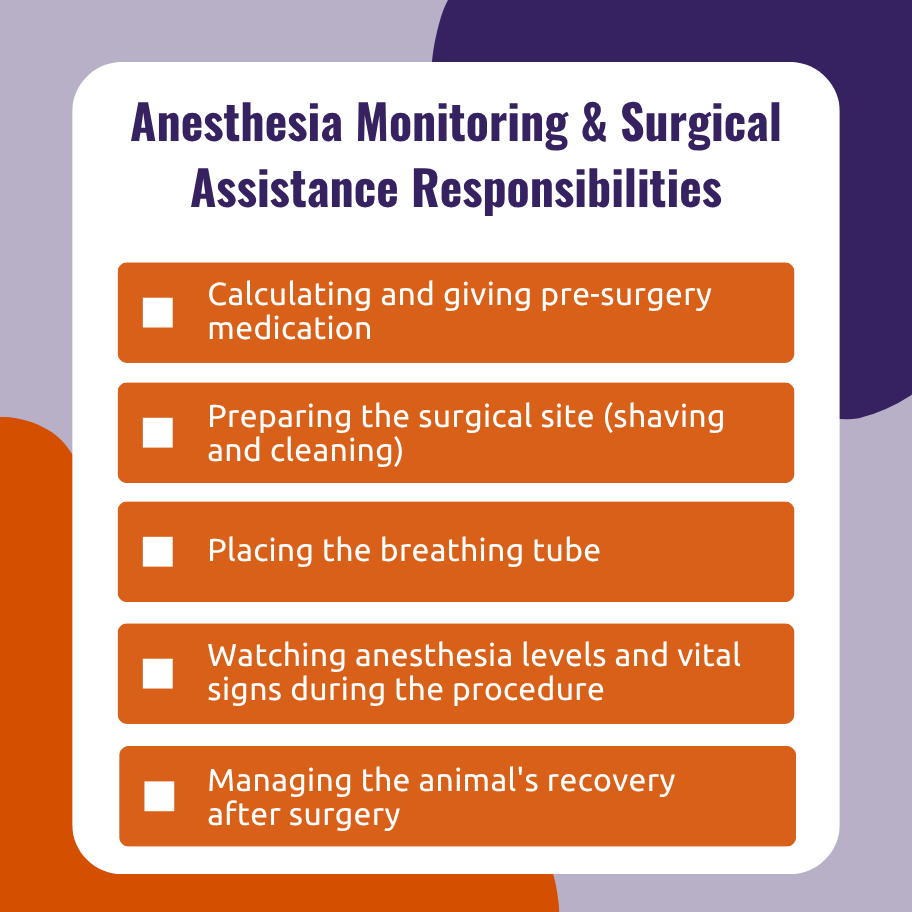
In MCC’s program, students practice anesthesia monitoring in hands-on labs before their clinical externships. Many students say this is one of the most complex skills they learn in the program.
Dental Cleanings, Vaccinations, and Nursing Care
Between surgeries and diagnostics, vet techs give vaccines, care for wounds, apply bandages, and give medication as prescribed. They also respond to emergencies like trauma, poisoning, or sudden illness, performing CPR or other lifesaving steps when needed.
Clinical skills are only part of the job. Vet techs also handle plenty of work without a veterinarian in the room.
Client Communication and Independent Tasks
Beyond the exam table, vet techs take on work that requires judgment and strong communication. They handle some tasks on their own. They also lead conversations with pet owners that shape the whole visit.
Educating Pet Owners on Treatment Plans and Preventive Care
A survey by the National Association of Veterinary Technicians found that 79% of vet techs teach owners how to give medication. Another 71% teach general pet care, and 56% talk about pain management [2]. Research from the AVMA shows that using clear, simple language in these talks builds trust and makes owners more likely to follow through on care.
A study in the Canadian Veterinary Journal looked at how pet owners learn about vaccines and parasites. Face-to-face talks with veterinary staff are still the top source, chosen by 89% to 92% of pet owners [3]. Vet techs often lead these conversations.
Tasks Vet Techs Handle Without a Veterinarian Present
Vet techs independently manage patient monitoring, checks after surgery, giving medication, and calling clients with updates. They collect samples, run routine lab tests, and get patients ready for procedures, often before the veterinarian steps in.
The skills that make a vet tech valuable in a clinic apply to other settings too, and demand for those skills is growing.
Where Vet Techs Work and Why Demand Is Growing
Private practice is the most familiar setting for a vet tech, but it’s far from the only one.
Settings Beyond the Private Clinic
Vet techs work in animal shelters, research labs, zoos, emergency hospitals, and specialty clinics. Companies like Labcorp hire vet techs for research animal work in states including Wisconsin. Relief staffing companies also hire qualified vet techs to fill shifts across hundreds of veterinary facilities.
Job Growth Projections and the Value Vet Techs Bring
The U.S. Bureau of Labor Statistics expects vet tech jobs to grow 9% from 2024 to 2034. That means about 14,300 openings each year [4]. The Florida Veterinary Medical Association found that each certified tech brings a practice more money. On average, that is an extra $161,493 a year [5]. BoosterPet, a veterinary services company, found that trained techs paired with telehealth visits made clients happier. It also made care run more smoothly [6].
The variety of work settings is one draw of this career. But an honest look at the job doesn’t stop at the duty list.
The Emotional and Physical Side of the Job
Vet techs work with animals that cannot explain what hurts. They sometimes help end a life to stop suffering. This side of the job is real, and it’s worth understanding before choosing this career.
Dr. Melissa Owings, president of the Michigan Veterinary Medical Association, says burnout and compassion fatigue have become more common in the field than she has seen before in her career [10].
Burnout, Compassion Fatigue, and Coping Strategies
A 2024 study found that more than half of vet techs, 58.6%, scored above the burnout threshold. About 73% reported high stress levels [7]. A separate survey of more than 1,600 vet techs found high emotional exhaustion and low confidence in their own work across the board [2].
Heavy workloads and exposure to euthanasia are two of the biggest causes. Difficult client conversations and low pay compared to school debt add to the strain [2]. The job also carries a high risk of injury, including bites, scratches, and kicks.
The same research points to what helps. Vet techs who have flexible schedules, get to use their full range of skills, and feel respected by coworkers report less burnout [2].
Specialization Paths That Can Shape a Long-Term Career
Vet techs can specialize in areas like dentistry, anesthesia, emergency and critical care, and zoo medicine [1]. Specializing can lead to higher pay, more independence, and a stronger sense of pride in the work.
Knowing what this job asks of a person matters before choosing it. So does knowing how it compares to similar roles, and what it takes to become one.
Vet Tech vs. Vet Assistant: How the Roles Differ and How to Get Started
People often use “vet tech” and “vet assistant” to mean the same thing. They are not the same role, and the differences in training, scope, and responsibility matter.
| Veterinary Assistant | Veterinary Technician | |
| Education | Diploma program | Associate’s degree (AAS) |
| Exam required | Not required | VTNE required in most states |
| Scope | Safe restraint, surgical prep, sample collection, medication administration, client education | All assistant duties, plus X-ray imaging, anesthesia monitoring, advanced lab diagnostics, nursing, and emergency care |
| Typical timeline | Months | About 1.5 to 2 years, depending on the school |
Most states require vet techs to pass the Veterinary Technician National Examination (VTNE) to become licensed, registered, or certified [8]. Depending on the state, that title may be called licensed (LVT), registered (RVT), or certified (CVT). Wisconsin currently certifies its veterinary technicians [9].
How MCC’s Program Structure Prepares Students for the Full Scope of Vet Tech Duties
Milwaukee Career College offers a Veterinary Assistant diploma and a Veterinary Technician degree. The two programs are separate but connected. Allowing students to use the Veterinary Assistant program as a stepping stone to their Vet Tech certification.
MCC is accredited by the AVMA through CVTEA, a group that reviews vet tech schools. The program takes 73 weeks to complete, about a year and a half, faster than the two years some vet tech programs take elsewhere. It includes hands-on labs and real clinical experience at vet practices. Graduates are ready to take the VTNE. Day classes are available, and so is financial aid for students who qualify.
Students interested in this career path can start by exploring MCC’s Veterinary Technician program.
FAQs
Is a vet tech basically a nurse?
Not exactly, but the comparison is close. Vet techs also do work that would belong to a phlebotomist, radiologist, and lab technician in human medicine, and they train to care for sick patients rather than diagnose them.
What can vet techs do that vet assistants cannot?
Vet techs handle advanced tasks like X-ray imaging, anesthesia monitoring, and emergency care, which fall outside a vet assistant’s scope. To do this, they must earn an associate’s degree and pass the VTNE in most states.
Is a vet tech a stressful job?
Yes. A 2024 study found that 58.6% of vet techs scored above the burnout threshold, though flexible schedules and respect from coworkers were shown to lower it.
How many years does it take to become a vet tech?
It depends on the school. Most vet tech programs run about two years, but Milwaukee Career College’s program takes 73 weeks, close to a year and a half, including the required Veterinary Assistant diploma.
Is it better to be a vet assistant or vet tech?
It depends on how much clinical responsibility you want. A vet assistant finishes training in months and handles basic tasks, while a vet tech earns a degree, passes the VTNE, and takes on advanced duties like anesthesia monitoring and X-ray imaging.
References
[1] https://www.bls.gov/ooh/healthcare/veterinary-technologists-and-technicians.htm
[2] https://pmc.ncbi.nlm.nih.gov/articles/PMC7303959/
[3] https://pmc.ncbi.nlm.nih.gov/articles/PMC8048202/
[4] https://www.bls.gov/ooh/healthcare/veterinary-technologists-and-technicians.htm
[5] https://fvma.org/maximize-your-technicians-and-increase-profitability/
[6] https://digitalempathyvet.com/the-future-of-veterinary-medicine-technician-centric-models
[7] https://pmc.ncbi.nlm.nih.gov/articles/PMC11783841/
[8] https://www.aavsb.org/students-exams/veterinary-technician-national-exam/